
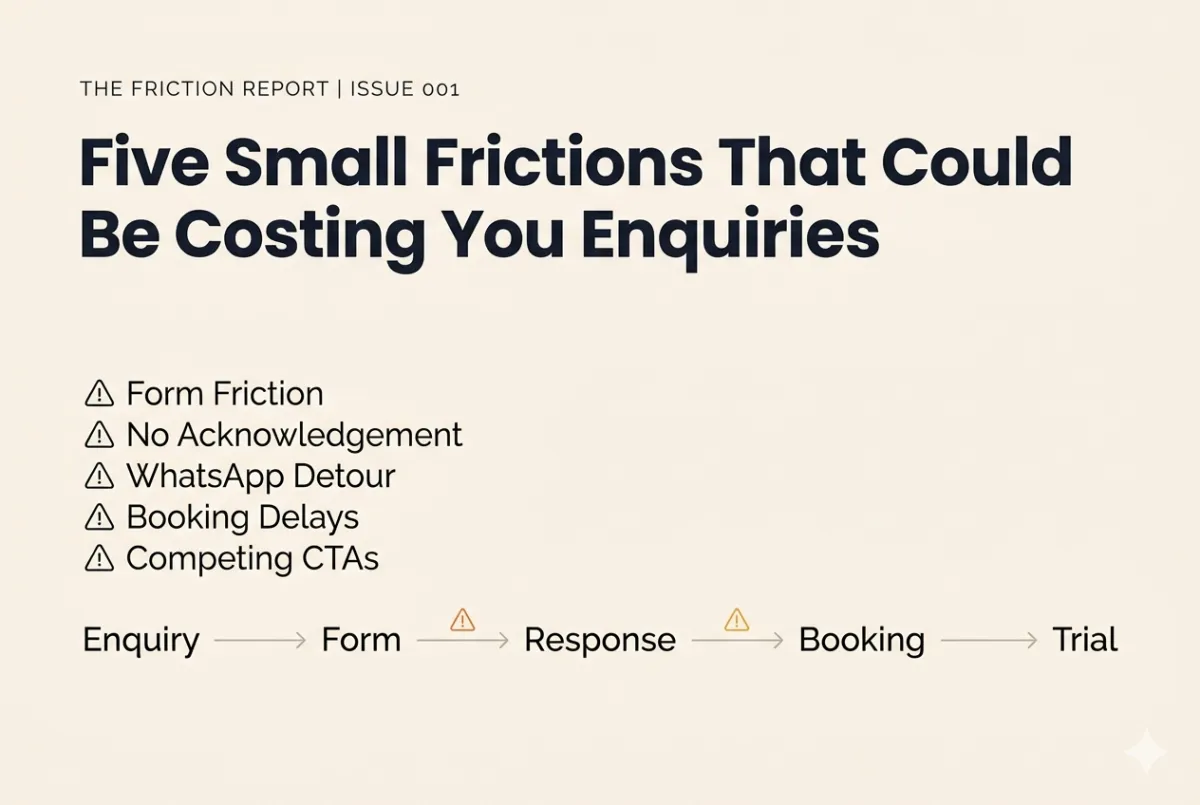
Five Small Frictions That Could Be Costing You Enquiries
Five Small Frictions That Could Be Costing You Enquiries
This week I reviewed the customer journey of an enrichment business.
Overall, the brand was strong, professional and well-positioned. The interesting part wasn't the website itself, it was what happened when I tried to enquire about a trial class.
Many business owners assume that if enquiries are slow, they need more marketing.
Often, they don't.
Sometimes they simply have friction in the customer journey.
Here are five common examples I see repeatedly across education, enrichment and service businesses.
1. Asking For Too Much Information Too Early
The trial enquiry form required a significant amount of information upfront.
Whilst detailed information is useful operationally, prospective customers are often still exploring their options when they first make contact.
Every additional field creates a small amount of friction.
The question worth asking is:
"What is the minimum information we need to start a conversation?"
Everything else can be collected later.
2. No Immediate Acknowledgement
After submitting the form, there was little indication of what would happen next.
As business owners, we know the enquiry has been received.
The customer doesn't.
Silence creates uncertainty.
A simple acknowledgement email or WhatsApp message can reassure the customer, confirm next steps and reduce the likelihood that they continue searching elsewhere.
3. The WhatsApp Journey Wasn't Really WhatsApp
Many businesses promote WhatsApp as a communication channel but then redirect users into another form.
This creates an extra step where there doesn't need to be one.
If a customer clicks a WhatsApp button, they expect to start a WhatsApp conversation.
The smoother the journey, the higher the engagement.
4. Booking Required Manual Follow-Up
The enquiry process relied on a team member arranging the trial after the initial enquiry.
There is nothing wrong with human interaction, but every delay introduces risk.
Momentum matters.
The closer you can bring the enquiry and booking experience together, the more likely a prospective customer is to take action.
5. Too Many Calls-To-Action
One of the most common issues I see is competing priorities on the same page.
In this case, a referral message sat alongside the trial booking journey.
Both are valuable.
But for a first-time visitor, the primary goal should be clear.
The more choices we present, the harder it becomes for people to make one.
What I Would Test First
Interestingly, I wouldn't start with a website redesign.
Most businesses jump straight to redesigning their website when conversion rates are lower than expected.
I would start much smaller.
A dedicated landing page focused entirely on trial bookings.
The objective would be to:
Simplify lead capture
Reduce enquiry friction
Automate acknowledgements
Enable self-service bookings
Improve visibility of enquiries and conversions
Run the test for 30 days.
Measure the results.
Then decide whether a wider website redesign is necessary.
The lesson is simple.
Most businesses don't have a lead problem.
They have an operational friction problem.
And operational friction is often hiding in plain sight.
— Stacey Hartley
Founder, empathAIse
Helping SMEs identify and remove operational friction.